

If you had asked me when I was a Christian what spirituality was, I would have told you it was God & us interacting in the spiritual realm. I would have seen this on purely Christian terms; so my perception was other religions weren’t interacting with God, they were interacting with evil spirits or demons.
After I deconverted my perception of spirituality changed almost overnight. I felt my experience of Christianity was something that I had been indoctrinated into, and I was now convinced my “relationship with God” had been imagined in my head.
The Fundamentalist Christians I grew up with probably believe I have been deceived by Satan, and that God is very much real. But there are also people out there, while not believers, that aren’t as cynical as I am, that don’t see my time praying & obeying as completely wasted. Lately I find myself standing on the shore of the sea of spirituality wanting to be open-minded, but not foolish.
What do we mean when we talk about spirituality? Is it the supernatural? What about things like yoga and meditation, are they still spiritual? The Cambridge Online Dictionary defines spirituality as:
‘[T]he quality that involves deep feelings and beliefs of a religious nature, rather than the physical parts of life’
Which is an interesting definition especially the part about ‘beliefs of a religious nature’.
The Merriam-Webster dictionary includes ‘religious values’ as part of one of its definitions, defining spirituality as:
‘[S]omething that in ecclesiastical law belongs to the church or to a cleric as such;
sensitivity or attachment to religious values;
the quality or state of being spiritual’
In the 2008 paper ‘Neurobiology of Spirituality‘ [nih.gov], Dr E. Mohandas defines spirituality and modifies the word religious with the words awe and reverence:
‘Spirituality involves as its central tenet a connection to something greater than oneself, which includes an emotional experience of religious awe and reverence. Spirituality is therefore an individual’s experience of and relationship with a fundamental, nonmaterial aspect of the universe that may be referred to in many ways – God, Higher Power, the Force, Mystery and the Transcendent and forms the way by which an individual finds meaning and relates to life, the universe and everything.’
Philip Perry’s definition on bigthink.com from 2018 goes even further by separating out spiritual experience from religion:
‘[A] spiritual experience is one that transcends the self and connects the person to the universe in a profound and meaningful way. This is separate from religion which often includes dogma, religious texts, and some sort of institution.’
The different definitions of spirituality above requires us, I think, to acknowledge spirituality means different things to different people. And obviously this is what is going on with language all the time.
I feel like once upon a time religion and spirituality used to be like this:
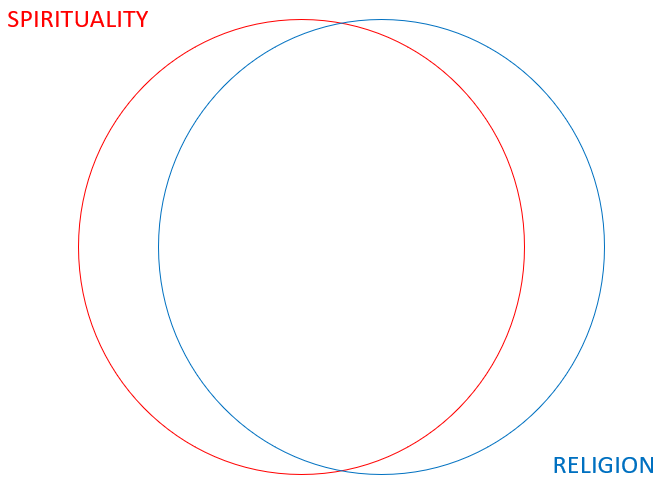
And is now going in this direction:
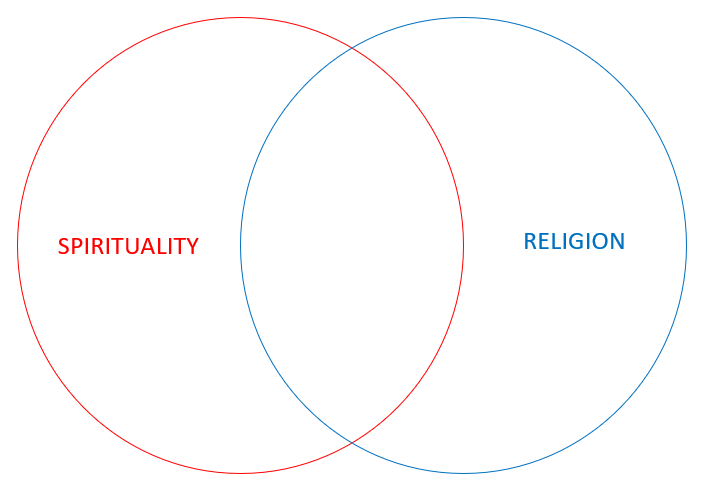
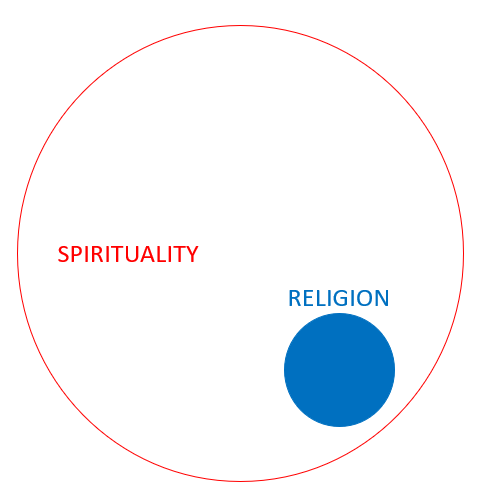
In the writing of this blog post, I’ve begun to think that in the future spirituality will encompass religion, with the possibility over time the religion circle will grow smaller as more and more people identify as “spiritual but not religious” [wikipedia.org]:
For me the elephant in the room is whether all spiritual experience is simply manifested in the brain and then acted out in the world.
There is plenty that has been written about parts of the brain that seem to be involved with spiritual experience, see: that same paper from 2008, that article on bigthink.com in 2018 by Philip Perry, or Alison Escalante writing on Forbes.com in 2021. In the Forbes article Escalante writes about how researchers have published a study where they report that ‘they have located a specific brain circuit for spirituality, found in the periaqueductal gray (PAG).’ Escalante goes on to say the PAG has been ‘associated with a wide range of functions: fear conditioning, pain modulation, altruistic behaviors and unconditional love.’ One of the authors of the study, Michael Ferguson, PhD, said: “Our results suggest that spirituality and religiosity are rooted in fundamental, neurobiological dynamics and deeply woven into our neuro-fabric,” and goes on to say “we were astonished to find that this brain circuit for spirituality is centered in one of the most evolutionarily preserved structures in the brain.”
A recent video from the U.S.’ National Endowment for the Humanities, and Wireless Philosophy [youtube.com], suggests that a possible future we are heading towards is one where our understanding of neuroscience is such that instead of understanding spirituality in terms of beliefs, fears, desires, and other mental states:
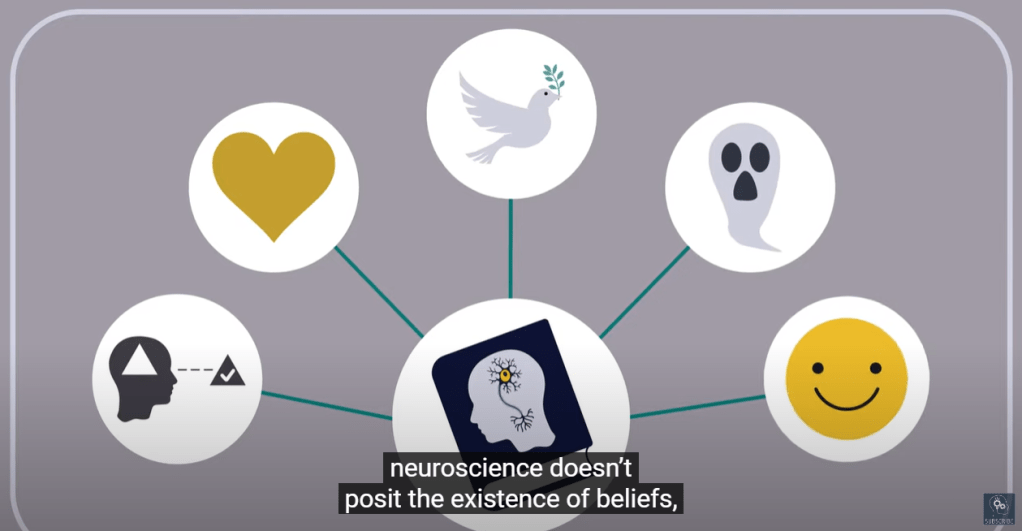
We will understand it in terms of brains, chemistry, physics, and mathematics:

I find it hard to predict what all this will mean for spirituality going forward.
Sometimes I have these moments of quiet despair, when I can feel hopeless, or worry about whether I’ve made the right choices in my life. At times like this I miss the comfort of an invisible power looking out for me. It makes me wonder about the trade-off, believing in something on faith for what it adds to your life versus using critical thinking and following the evidence. On the good days I’m happy to be a rationalist but on the bad days I wonder if a little bit of magical thinking would be so bad.
Standing here next to the sea of spirituality I can actually see a possible future where spirituality is defined without referring to religion except historically. But I also wonder if the parts of “spirituality” I’m adopting, the ones stripped of their mystical roots like mindfulness breathing & yoga poses, is leaving parts of the experience & the benefits of spirituality behind.
 Oblivion With Bells