

Who wants to talk about the climate emergency? Who is excited to talk about the climate emergency? A show of hands? Maybe if I was at a Green Party meeting I might get an enthusiastic response, but I’ve found in general most people would rather not talk about it.
I think we all exist in one of two groups about climate: we must take action, or we don’t need to do anything about it. I would guess that most of us, but not all of us, are members of the We Must Take Action group.
But what does it mean to be part of this group? Are we all actually taking action, and if so, what does this action look like? And if most of us agree We Must Take Action, why don’t we want to talk about it?
Let me ask you another question: have you read Seth Wynes and Kimberly A. Nicholas’ letter to the Institute of Physics from 2017? My guess is you probably haven’t. There’s a small chance you may have read the article about it The Guardian published the same year. Helpfully The Guardian summarises the key finding of the letter with this graphic:
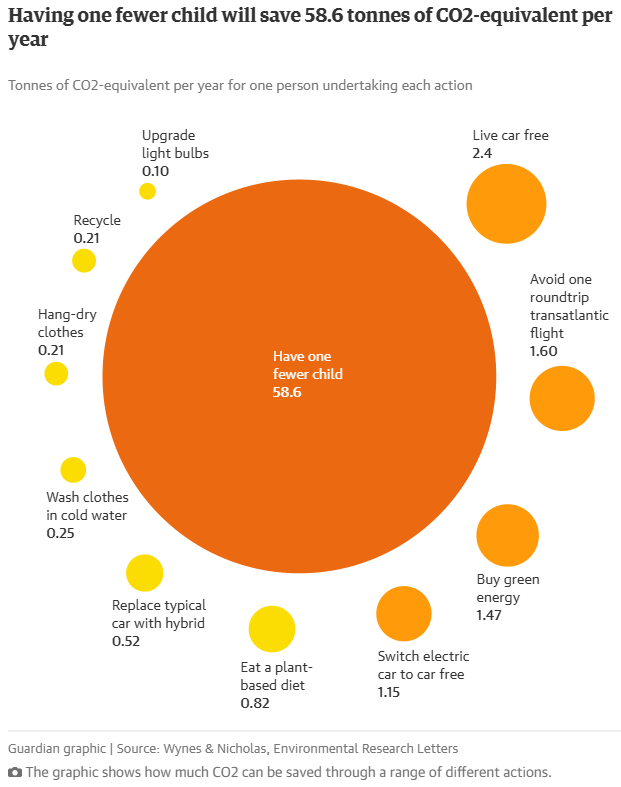
As you can see, when it comes to individual decisions we each can make when it comes to taking action to reduce our CO2 footprint, having one fewer child is the most significant step we can take, by some distance. The next most significant step is going car-free.
I personally think about this graphic at least once a week. I am still not sure if that is too much, about the right amount, or not enough. What I find particularly jarring is the disconnect being part of the We Must Take Action and the top five steps: Have one fewer child than you are planning to, go car-free, fly less, buy green energy, and eat a plant-based diet. After all, ask yourself this question: when was the last time you had a meaningful conversation with someone about these top five steps?
What it makes you realise is, while most of us might be part of We Must Take Action, there seems to be much less agreement about What & How we must take the aforementioned action. What one starts to conclude is that what actually really matters is how many members of the We Must Take Action group choose to actually take action. And if you think about this long enough you start to wonder: is it really a majority of us that belong to the We Must Take Action group? Because if we are not doing the most effective steps then what is the point?
You may, at this point, be wanting to say to me: “But Dave, 70% of emissions come from 100 corporations.” True, but I’ve never understood this argument. One, shouldn’t we be trying to reduce emissions everywhere we can? And two, aren’t we the ones ultimately buying from these corporations? It’s not like these corporations are just making stuff for the fun of it.
Back in 2022, enthused by what I thought was critical climate information that was easy to communicate, I made my own Top 5 graphic for the top five steps. But I found it wasn’t a huge engagement driver, in fact the only place where people engaged with it in any serious capacity was on Mastodon (“the fediverse”) but even there a lot of the comments I got amounted to “what do you want from me!” It was strange, it was like at best what I was sharing was an inconvenience but at worst actively offensive. Weren’t we all in this together as part of Team Must Take Action?
In my own life I’ve tried my best to take the top five steps. My partner and I are vegetarians, we buy green energy, and we haven’t been on a plane in over a decade. But we haven’t gone car-free yet, and most importantly we’ve decided to have both the children we were planning to have. I have no good excuse for this. My partner and I simply decided what we wanted was more important than the increase to greenhouse gases it would cause. This is a hard thing for me to acknowledge.
But maybe this offers a clue to why many of us might agree in theory that We Must Take Action but actually when it comes to the hard work of taking the most important steps we are unwilling to change our lifestyles. We would rather not talk about it, or be reminded about it, because our selfish hearts are at war with our rational minds.
Recently I read a post that was talking about how some of the things we will need to do this century to adapt to sea level rises will include getting better at growing our own food, and setting up our homes to handle regular energy blackouts. The difference between this future that is coming and a present where we prioritise buying LED lightbulbs can feel dizzying. My question is not how can we motivate people to take action about the climate emergency, but how to get people to take the right action? Let me know in the comments 👍⬇️
 Oblivion With Bells