“Thoughts & prayers” is really just “thoughts”

A photograph of an open notebook. On one page it says "Here we go" and on another page the words "I will sell out the Roger Center" are written on every line of the page.

Recently I found myself watching a documentary about Shawn Mendes, a Canadian pop singer/song-writer. During the documentary we learn about Shawn’s ambition to not just play at but to sell out a stadium in Toronto called the Rogers Center. Part of the film showing us this journey is seeing a journal where Shawn has written the same thing again and again: ‘I will sell out the Rogers Center’. What was he doing, and why was he doing it?

Apparently, this is something called manifesting, which has recently been given a boost thanks to the pandemic and the Tiktokification of information. Manifesting has become a very broad term and means different things to people. On one hand you have the concept of “if you believe in it enough it will happen”, the “law of attraction” and books like The Secret. But more recently the definition of manifesting has expanded to include such things as CBT (Cognitive Behavioural Therapy), planning, visualising, and positive thinking. For this reason I think a better term for the pernicious type of manifesting is “magical thinking“.

Given this, where does Shawn Mendes writing the same thing again & again sit on the manifesting spectrum? I’m not sure to be honest, probably somewhere in the middle. Pretty harmless but best not indulged too seriously. Because as others have written, magical thinking has a risky downward spiral built into it which is: if your dreams don’t happen for you, maybe you didn’t want them/believe in them enough. But at the same time, Shawn Mendes combines his manifesting with action, and in the film does end up selling out the Rogers Center. Good for him I suppose.

When I was a Christian there was a thing called a “testimony”, this was your story of “how you became a Christian” and was often used in recruitment, trying to get other people to become Christians. Part of my testimony when I was a Christian was how on my very first day when I started working for the Church of England we had a guy called John Mumford speak at staff meeting and he prayed for the entire staff. And while he was doing that he said “now some of you your hands or your top lip will be tingling right now” and if that was you you were to come forward to get prayed for. Now my top lip was tingling which I thought was amazing, and later on I used to tell this story as part of my testimony & highlight how God had got my attention by causing my top lip to tingle. Then one day a Christian friend heard that story and said “oh the tingling lip thing, yeah John’s been doing that for years”. And it turns out getting pins and needles or tingling sensations in your body, especially during moments of high emotion is not uncommon. And I remember feeling like a sucker, and later on when I deconverted realising that this guy had just been using normal body reactions but putting a Christian veneer over them.

Really, with a sufficient understanding of confirmation bias most secular people would understand that prayer is just magical thinking with a different name. There is a specific type of groupthink that goes on that allows prayer (the kind of prayer that the Christian God supposedly answers) to persist. I’m stealing this from a very good YouTube video that I haven’t been able to find, but it goes like this: if you pray to God, and he answers your prayer, God is real and good; if you pray to God, and he doesn’t answer your prayer, then either God is real and there is a good reason he hasn’t answered your prayer, or God is real and you need to Wait and there is a good reason you need to wait. So you see if you submit to this idea of prayer God is real and he never fails.

I don’t know how many Christians know that they have tested empirically whether prayer works and the results were incredibly underwhelming. But then I suppose Christians would argue that the Bible says “do not test the Lord your God” (Deuteronomy 6:16), which is convenient. But then the Bible also says to “test everything” (1 Thessalonians 5:21) so who knows.

In the world I see one day we will be post-religion and we will use the phrase “I’m thinking of you” instead of “I’m praying for you”. And we will back up our words with caring action when we can, instead of petitioning a deity we have created in our minds.

Book review: The Denial of Death, Escape From Evil

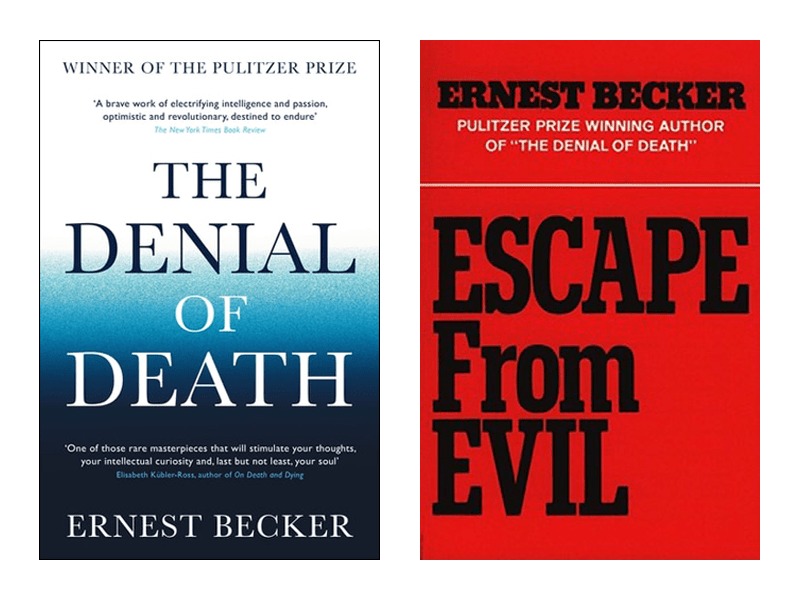
Book covers of two books by Ernest Becker: The Denial of Death and Escape From Evil.
(above) The Denial of Death and Escape From Evil, both by Ernest Becker

My background for wanting to read these books is deconverting from my Fundamentalist Christian beliefs in 2017. I knew I wasn’t going to Heaven, so suddenly death was final & more scary. When I first read The best books on Fear of Death recommended by Sheldon Solomon from Five Books I felt some encouragement that there were people out there thinking about death & wrestling with what it means.

From the Five Books article it is clear Sheldon Solomon thinks Becker is an important stop on the road to understanding fear of death. I tried to read Escape From Evil first but because I had done so little reading on this topic I lacked the background to understand it easily, so reading Denial first seemed mandatory. Denial of Death comes first chronologically and is the one he completed before he died (his widow published Escape). Denial of Death I think lays the platform for Escape. Escape From Evil is the better, more concise book, but I think Denial is essential reading to get the most out of it.

In Denial of Death Becker makes his case for fear of death affecting all areas of our lives. He sees the major breakthrough in understanding this as being Freud’s, but, writing in the 1970s, he thought Otto Rank (a disciple of Freud) had built the most on Freud’s work on existentialism. Becker makes a compelling case but stops short in Denial of suggesting a way forward. You get the feeling he felt compelled to have a go, and Escape was probably going to be his attempt.

Denial of Death is over 50 years old now. The stuff in there about mental health feels very outdated. I don’t know where he was coming from about homosexuality & transvestism. The attempt to psychoanalyse Freud’s two known fainting spells feels too long. The summaries of Kierkegaard and Rank’s bodies of work are fascinating; as is his conclusion that those two thinkers thought that the cosmic heroism embedded in religion was the best treatment for the fear of death. Indeed, Becker goes as far as to say ‘The urge to cosmic heroism, then, is sacred and mysterious and not to be neatly ordered and rationalized by science and secularism. Science, after all, is a credo that has attempted to absorb into itself and to deny the fear of life and death; and it is only one more competitor in the spectrum of roles for cosmic heroics.’

Combined together, Denial of Death & Escape From Evil are the most important books I have read in the last 10 years. They are still massively relevant today and our reckoning with their questions & challenges as a species is way overdue. Chapters 1 and 2 of Escape From Evil seemed to me to be mostly an attempt to provide the reader with some of the background he covered in Denial. Readers of Denial of Death can probably pick up from chapter 3 onwards. Becker takes as his starting point that fear of death shrouds & affects all our waking moments, and goes on to show how inequality, status, genocide, the accumulation of capital/possessions/power are all symptoms of our failure to ultimately reckon with death-terror. Reading the last chapter, Becker seems caught between humility and honesty. He says ‘No one mind can pose as an authority on the future; the manifold of events is so complex that it is fraud for the intellectual to want to be taken seriously as a prophet, either in his fantasies or in his realities.’ But then on the same page he says ‘Yet I think that there is a solid minimum achievement’. Becker’s prescription? Progressive politics and a “science of society”. I was underwhelmed by this but I was probably expecting too much.

Losing my religion

I identified as a Christian for my whole life until two weeks in 2017 changed all that. In the subsequent seven years since then I’ve been trying to work out whether I really deconverted then or if that train had been a long time coming. I still don’t really know, but it’s probably more the latter than the former.

As I’ve blogged about before, I was indoctrinated into Christianity from birth. The particular version of Christianity I grew up in was what I call Fundamentalist Evangelical Christianity. The way I define this is it was Fundamentalist in that we believed the Bible was the literal “Word of God”. And Evangelical in that the type of church my family attended was of the Evangelical tradition, meaning it was different to say Baptist or Presbyterian traditions.

What that means is that I grew up under the eye of God. I understood that God knew everything, that everything came from Him, and He had a plan for my life. And although I might stray from this plan, and naturally rebel at times, I should expect to always find myself coming back to Him, apologising for straying, and recommitting myself to His plan for me. Looking back now, I wonder why I didn’t leave Christianity as I got older and could think more for myself. Some days I tell myself it was because I wasn’t equipped with the critical thinking skills necessary to do that. But other days I think I may have wanted the things Christianity promised me too.

Doubt in God is built into the Christian system. You are taught, even expected in a way, that you will have doubt about your faith from time to time. But you will always find your way back to God, along with a stronger faith because you’ve learnt that God was there all along. No doubt you’ve heard or seen about the classic Christian poster of two sets of footprints in the sand. So in 2016 when I started having doubts about my Christian faith, a part of me assumed I was just suffering a classic seasonal bout of the doubting blues.

Christian belief, in the Fundamentalist form, is a completely different interpretation and understanding of reality. God created the universe, he created all living things, he created humans with free will, but his humans chose to use this free will to live differently to the way God intended – they were living in sin. So God sent Jesus Christ to allow his humans to apologise for being sinful; Christians are taught that Jesus takes their sins so God “sees” Christians as being free from sin. Why is this important? Well the stakes are eternal, live in sin and when you die you are separated from God for eternity, but repent of your sin through Jesus Christ and when you die you live with God & Jesus Christ in Heaven for eternity.

As I’ve gotten older, and particularly since I deconverted from Christianity, I’ve learnt that some Christians didn’t have eternal stakes on their mind much at all. Some Christians were focused on just trying to live how God wanted them to, to get to Sunday feeling like they were mostly doing their best. But growing up I was a conscientious, intellectual young man whose mild OCD manifested in a strong, often overwhelming, desire to be right with God and to play my part in the eternal battle of good and evil. God had sent Jesus to share the Good News, the Devil wanted to deceive people, how was I going to make sure people heard the Good News? How should I serve God with my life?

So early in my 2016 season of doubt I didn’t anticipate I was going to abandon my faith at all. I reassured my Christian wife I was just going through a period of doubt, nothing to worry about. I talked to Christian friends, I prayed, I saw my pastor who recommended some books to read.

But the books didn’t serve their intended purpose. The tone of my concerns began to get more panicky. I can remember evenings outlining my issues with a certain fact of Christian theology and my wife’s worried face looking back at me. My therapist wasn’t any help either, although since he wasn’t a believer I didn’t expect him to understand or be able to help me.

What I found myself saying was that I was starting to believe the whole thing was made up. When Christians talked about the “still small voice of God” they were talking about the sound of their own mind talking back to them. For me the bottom had fallen out of my faith. I thought that if the foundation of it, whether there was actually a God who really existed, was false I didn’t see how I could continue believing.

As I wrote that last paragraph I got a warning from my Apple Watch that my resting heart rate had risen above 100 bpm. And that’s what it was like at the time: sweating bullets while well-meaning Christians tried to tell me I just needed to see the present darkness through. But it’s one thing to overcome your present troubles, it’s another thing to look back upon your life and start asking yourself “What was that? Could I have been raised with an illusion? And then taught how to produce the illusion for myself?”

After all, we convince ourselves of things all the time. That democracy is good. The government is in control. That she loves you. That things are going to get better. But time passes and we see things differently. Democracy is imperfect. Our governments lie. If she did love you, she doesn’t anymore. And I thought, if the question is do I want to believe in something because of the benefits it gives me, regardless of whether or not it’s real, then for me the answer was becoming clearer & clearer. The same young man that grew up a zealous Christian wasn’t going to be zealous when something that wasn’t real, wasn’t true.

My wife and I were living at the time in a place called Worcester Park in London in the UK. Because of my chronic illness I wasn’t well enough to work so I found myself going for long walks at the park and through the local woods, looking at the treetops and thinking about cosmology. One day, walking on a cloudy day, I thought to myself “What if I got onto my knees and prayed right now, would that be a sufficient act of devotion and desperation for God to reveal Himself to me?” Right then I knew that there would be no point. God couldn’t reveal himself if he didn’t exist.

I showed up at my next therapy session freaking out. What if I didn’t believe? What would that do to my marriage? My relationships with my parents? My brother and sister? I had never shown up to therapy that desperate or emotional before, it felt like the sky was falling and I was powerless to stop it. Looking back, that was the high water mark. The next therapist session I showed up still stressed but also still alive & breathing. The sky was still kind of falling, but on some level I was also happy to be finally acknowledging where I was at. I wasn’t pretending anymore and that felt good.

Eventually I settled on a kind of trial break. Maybe for a week or two, I wouldn’t be anything, not Christian, or non-Christian, I would just exist with my current beliefs and doubts and not force myself to believe in anything. Incredibly, those two weeks passed without incident. More weeks passed. Eventually I would realise in fact I had been on a long journey towards not believing and I had finally arrived. It was a strange kind of peace. I felt like I had been believing impossible things for so long because my marriage, my relationship with my parents, my whole life was based on it. It felt very uncomfortable but at least it didn’t feel insane anymore.

Much later on with distance, time, therapy, and healing I was able to take the well-meaning things Christians were saying to me. I now found myself on the other side of Christian culture and felt ashamed that once upon a time I had said those same well-meaning things. There was a feeling of fresh evangelism for my new (non)beliefs and a desire to convert Christians to them. In time I have found this desire has faded a little too. While I wish Christians didn’t believe the things they do, and didn’t raise their children in those beliefs without giving them the choice, I also understand these are not easy decisions to make. After all, if you feel powerfully that your beliefs are true and life affirming and transformative, why wouldn’t you share them with your children? I find myself looking at fundamentalist Christians these days and thinking, I guess you need Christianity, and maybe one day, like me, you won’t.

The sea of spirituality

If you had asked me when I was a Christian what spirituality was, I would have told you it was God & us interacting in the spiritual realm. I would have seen this on purely Christian terms; so my perception was other religions weren’t interacting with God, they were interacting with evil spirits or demons.

After I deconverted my perception of spirituality changed almost overnight. I felt my experience of Christianity was something that I had been indoctrinated into, and I was now convinced my “relationship with God” had been imagined in my head.

The Fundamentalist Christians I grew up with probably believe I have been deceived by Satan, and that God is very much real. But there are also people out there, while not believers, that aren’t as cynical as I am, that don’t see my time praying & obeying as completely wasted. Lately I find myself standing on the shore of the sea of spirituality wanting to be open-minded, but not foolish.


What do we mean when we talk about spirituality? Is it the supernatural? What about things like yoga and meditation, are they still spiritual? The Cambridge Online Dictionary defines spirituality as:

‘[T]he quality that involves deep feelings and beliefs of a religious nature, rather than the physical parts of life’

Which is an interesting definition especially the part about ‘beliefs of a religious nature’.

The Merriam-Webster dictionary includes ‘religious values’ as part of one of its definitions, defining spirituality as:

‘[S]omething that in ecclesiastical law belongs to the church or to a cleric as such;
sensitivity or attachment to religious values;
the quality or state of being spiritual’

In the 2008 paper ‘Neurobiology of Spirituality‘ [nih.gov], Dr E. Mohandas defines spirituality and modifies the word religious with the words awe and reverence:

‘Spirituality involves as its central tenet a connection to something greater than oneself, which includes an emotional experience of religious awe and reverence. Spirituality is therefore an individual’s experience of and relationship with a fundamental, nonmaterial aspect of the universe that may be referred to in many ways – God, Higher Power, the Force, Mystery and the Transcendent and forms the way by which an individual finds meaning and relates to life, the universe and everything.’

Philip Perry’s definition on bigthink.com from 2018 goes even further by separating out spiritual experience from religion:

‘[A] spiritual experience is one that transcends the self and connects the person to the universe in a profound and meaningful way. This is separate from religion which often includes dogma, religious texts, and some sort of institution.’

The different definitions of spirituality above requires us, I think, to acknowledge spirituality means different things to different people. And obviously this is what is going on with language all the time.

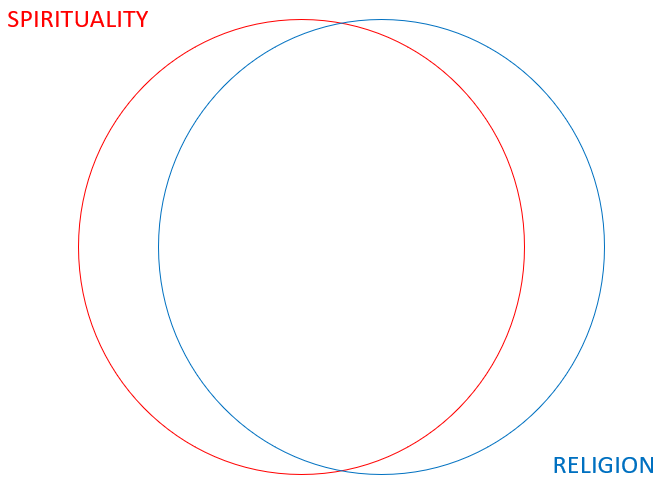
I feel like once upon a time religion and spirituality used to be like this:

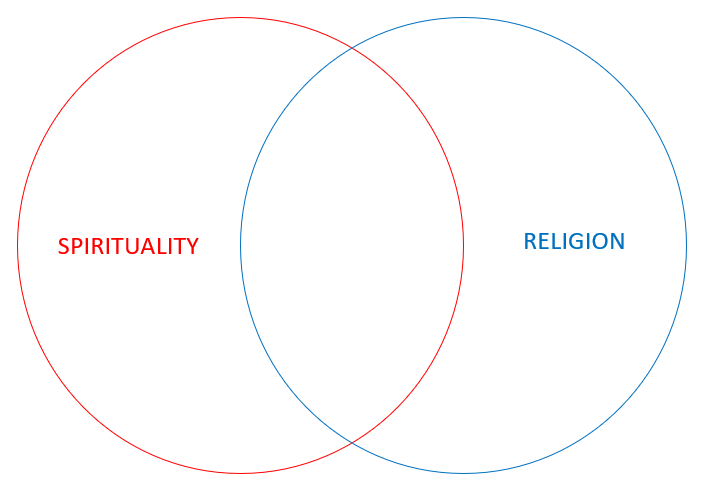
And is now going in this direction:

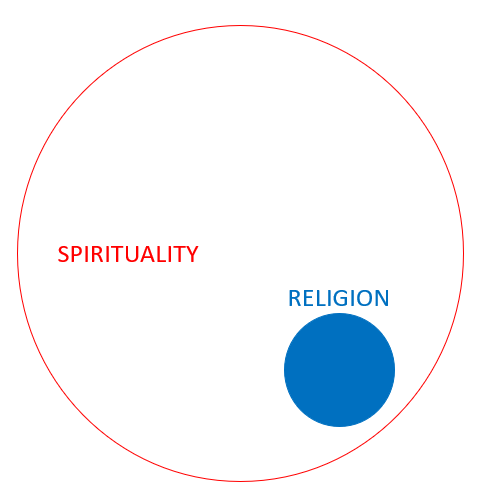
In the writing of this blog post, I’ve begun to think that in the future spirituality will encompass religion, with the possibility over time the religion circle will grow smaller as more and more people identify as “spiritual but not religious” [wikipedia.org]:


For me the elephant in the room is whether all spiritual experience is simply manifested in the brain and then acted out in the world.

There is plenty that has been written about parts of the brain that seem to be involved with spiritual experience, see: that same paper from 2008, that article on bigthink.com in 2018 by Philip Perry, or Alison Escalante writing on Forbes.com in 2021. In the Forbes article Escalante writes about how researchers have published a study where they report that ‘they have located a specific brain circuit for spirituality, found in the periaqueductal gray (PAG).’ Escalante goes on to say the PAG has been ‘associated with a wide range of functions: fear conditioning, pain modulation, altruistic behaviors and unconditional love.’ One of the authors of the study, Michael Ferguson, PhD, said: “Our results suggest that spirituality and religiosity are rooted in fundamental, neurobiological dynamics and deeply woven into our neuro-fabric,” and goes on to say “we were astonished to find that this brain circuit for spirituality is centered in one of the most evolutionarily preserved structures in the brain.”

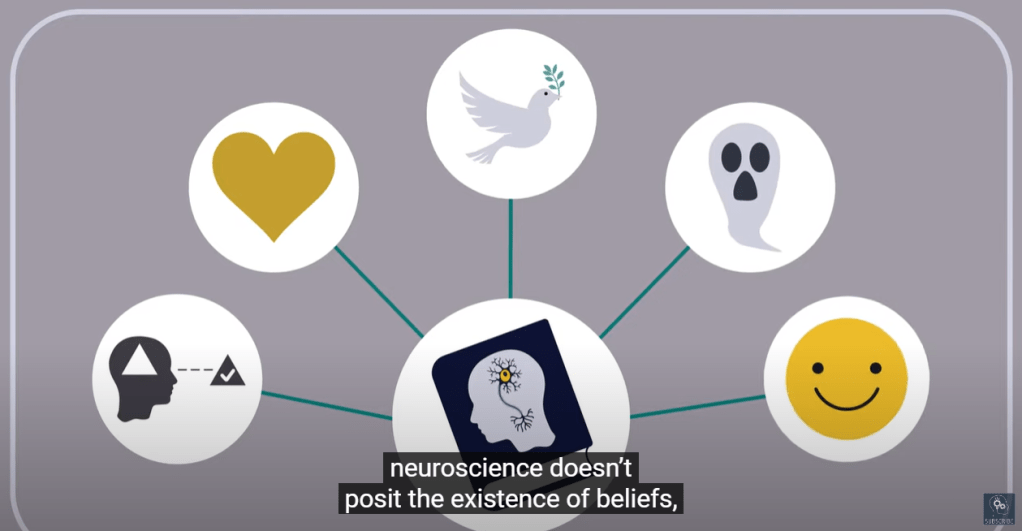
A recent video from the U.S.’ National Endowment for the Humanities, and Wireless Philosophy [youtube.com], suggests that a possible future we are heading towards is one where our understanding of neuroscience is such that instead of understanding spirituality in terms of beliefs, fears, desires, and other mental states:


We will understand it in terms of brains, chemistry, physics, and mathematics:


I find it hard to predict what all this will mean for spirituality going forward.

Sometimes I have these moments of quiet despair, when I can feel hopeless, or worry about whether I’ve made the right choices in my life. At times like this I miss the comfort of an invisible power looking out for me. It makes me wonder about the trade-off, believing in something on faith for what it adds to your life versus using critical thinking and following the evidence. On the good days I’m happy to be a rationalist but on the bad days I wonder if a little bit of magical thinking would be so bad.

Standing here next to the sea of spirituality I can actually see a possible future where spirituality is defined without referring to religion except historically. But I also wonder if the parts of “spirituality” I’m adopting, the ones stripped of their mystical roots like mindfulness breathing & yoga poses, is leaving parts of the experience & the benefits of spirituality behind.

Quote Post: Julia Scheeres

Julia Scheeres on survivng religion:
 
'I can no longer have blind faith in creeds, because I am no longer blind.'
 
— Jesus Land by Julia Scheeres

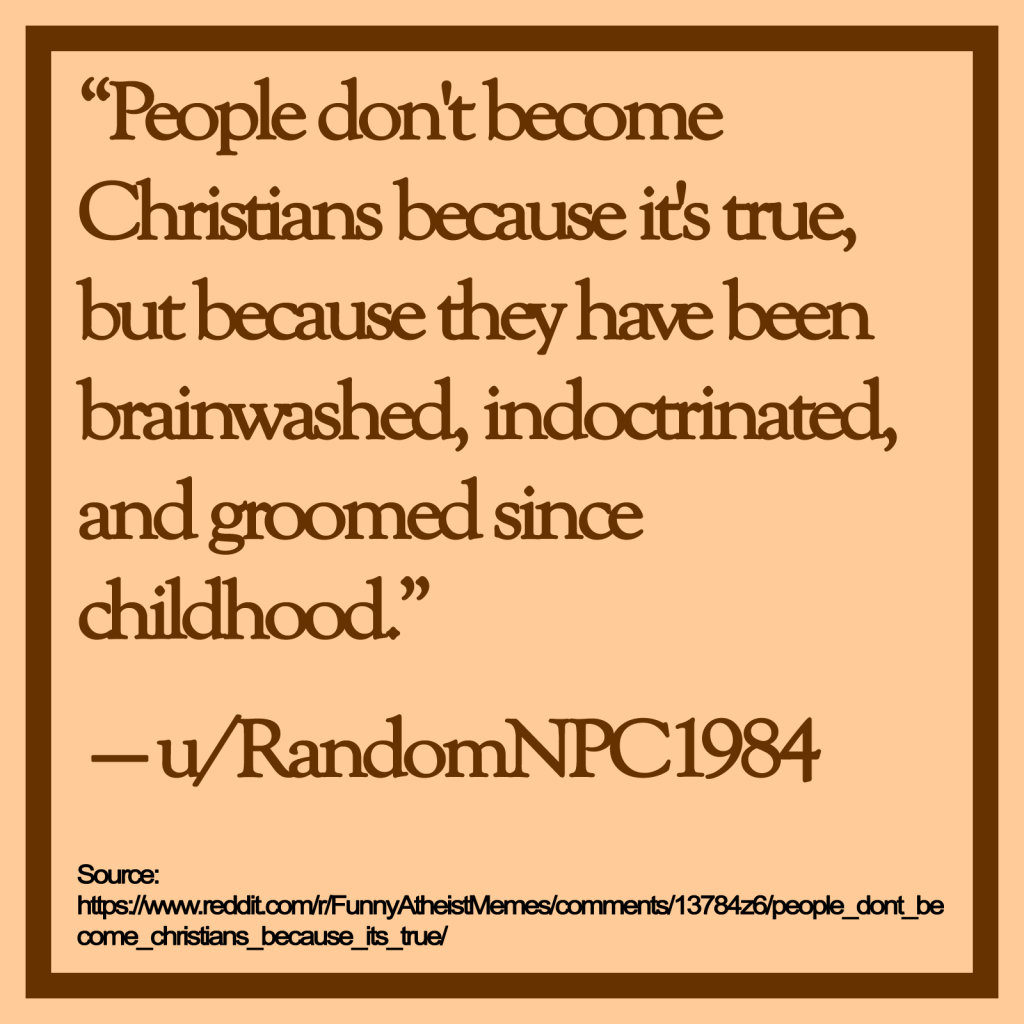
Quote Post: “People don’t become Christians because it’s true”

"People don't become Christians because it's true, but because they have been brainwashed, indoctrinated, and groomed since childhood."

— u/RandomNPC1984

Source: https://www.reddit.com/r/FunnyAtheistMemes/comments/13784z6/people_dont_become_christians_because_its_true/

Childhood methods of coping with fear of death that can carry through to adulthood: ‘I Am Special’, and ‘Supernatural Rescuer’

Screenshots from Existential Psychotherapy by Irvin Yalom:

Adversity (deconverting from Christianity, living with ME/CFS)

I was born in the early 1980s in New Zealand. My father was a forest ranger and one of my earliest memories is standing at the edge of a looming pine forest. My parents are Fundamentalist Christians and raised me in those beliefs. Ultimately I think religion and New Zealand were the strongest influences on me growing up.

My Dad got a job as a builder and we moved to the city. I guess we were roughly lower middle-class. My Dad worked two jobs and Mum sewed a lot of our clothes. Later, Dad got a job as the property manager of a girls high school so we moved again. My brother and sister and I were now going to school in a wealthy part of the city. Geographically we hadn’t moved very far but it felt like everything had changed. Rich kids lived completely different lives.

After high school, I studied Communications at university which ended up being almost too general a degree to get a job. My Christian upbringing had taught me I should serve God, so I got an internship at a Christian music company and after that worked at a conservative Christian thinktank. When I got let go by the thinktank I found a job as an “Internet Marketing Consultant”.

Digital marketing in the mid-2000s was stuff like search engines and online advertising. I didn’t know anything about those things but I learned. Internet marketing felt like a new industry that was growing. I seemed to be ok at it, and I liked feeling good at something.

Eventually I got the chance to manage people. It was hard. I never received any formal training; one day I wasn’t a manager and then the next day I was. I wasn’t particularly great at managing people but I liked the feeling of being an Important Manager-Type Person. I started working harder and longer. I had mornings where I would sit at the bus stop with a tight chest, feeling like I couldn’t get one good deep breath. It never occurred to me at that time that I might have been struggling with stress & anxiety. No one I knew talked about that sort of stuff. I just assumed it would pass and that I needed to push through it.

In 2008 I ran myself into the ground and got glandular fever. I failed to recover from that and was diagnosed with Chronic Fatigue Syndrome or CFS. CFS, or ME (Myalgic Encephalomyelitis), was barely understood back then. My ME/CFS meant I was really struggling to do my job. Eventually the head of my department had to demote me and take over my responsibilities. I felt like a failure.

My doctor told me to take up jogging to treat my chronic exhaustion, something doctors these days would never recommend for ME/CFS. It was a cheat, I would feel exhausted & fatigued, go for a run and then live off the adrenaline for a few days, then repeat the cycle. At the time I thought I had found the solution to my health problems, so in the early 2010s I left New Zealand and moved to the UK.

It took seven months but eventually I found a job in London doing web analytics. I liked web analytics but felt like at times I would be a better analyst than a consultant. I met the woman who would become my life partner and I started to feel settled in Britain. I felt like I needed to find a job that more directly “served God” so I started looking for roles in the charity/non-profit sector.

A housemate at the time recommended I see if there were any jobs with Alpha International. Alpha International is a Christian charity based in London which develops & promotes a course introducing people to Christianity. They were looking for a social media manager. I could only remember a little bit about the course but I was intrigued. I thought maybe managing social media would suit the soft skills I had and I liked the idea of working for a Christian charity so I applied & got the job.

As I wound down my web analytics job, I was working hard to get a project finished which required a lot of repetitive computer tasks. I started experiencing severe pain in my right forearm and then the same pain in my left forearm. I was forced to go on permanent sick leave before finishing up at that job and started seeing physios & specialists to find out what was wrong with my arms. The diagnosis at the time was that it was RSI or Repetitive Strain Injury. I learnt to operate a computer via voice dictation and asked Alpha International if we could delay my start date in order to give my arms time to heal.

I tried to be brave, and hoped God would miraculously heal me, but I was frightened. Getting ME/CFS originally had been traumatic and I think I was having flashbacks to that with the RSI. I was afraid to tell people just how severe it was. I didn’t want my partner wondering how I was going to “provide” for us. I didn’t want Alpha International to start having doubts about offering me the job.

Eventually Alpha International were like “when can you start?”. My arms weren’t getting any better but the hope was I could rehabilitate them at the same time as starting my new role. This meant from the outset I was going to have to use voice dictation to use my computer. The first time trying to use voice dictation in a dead quiet open plan office was embarrassing, it took just 20 seconds for me to realise that it was never going to work. I had a hilarious meeting with an accessibility adviser who told me I could wear a special hood over my head that would muffle the sound of my voice. Eventually I found a dusty cramped video tape archive room where I was safe to do voice dictation and that became my working space for the next three years. For my arms I would see specialists, have different tests, and try different medicines but none of it helped. To this day I am still reliant on voice dictation software and a foot mouse to use a computer.

Alpha International was connected to a church called HTB or Holy Trinity Brompton. At the time I felt pretty neutral about this, as far as I knew I would be working for Alpha International. On my first day on the job I found out I would be working for both Alpha International and HTB. This seemed a bit odd, but I wanted everyone to like me & didn’t want to cause problems so I didn’t say anything about it.

Doing social media for HTB turned out to be a stressful time suck. It was an unrewarding grind that had an obvious contradiction at its core: I did not attend HTB Church. It was like working for one football team but supporting another. Your employers knew they had your loyalty because they paid you, but they also wanted you to be loyal in your heart. When I reflect on why I let myself get stuck in that situation, the answer is because of my lack of self-worth. I wanted to be Successful Social Media Guy For A Large Church In London. I was willing to put up with a lot to have that.

After two years of some hits & misses I was tired of being stretched too thin and not getting enough support from my managers. Maybe social media management looks different elsewhere, but for me it was nearly all stakeholder and online reputation management. All for a church I didn’t know or like. I requested a shift back to analytics work, but by that time the web development and analytics work was in the process of being outsourced from the organisation entirely. And if you think doing social media management via voice dictation is hard, try working on spreadsheets. I couldn’t deliver in my role, but I had no idea how I was going to get another job. I was miserable.

In 2016 my ME/CFS symptoms got worse. Like when I first got glandular fever, I was running myself into the ground again. I had a meeting with the head of the department who said “you’re struggling”, I said “I can quit”, and he said “ok”. And that was it. I was so fatigued, anxious, and unhappy, I leapt at the chance to leave. Ever the conscientious Christian, I worked hard right up until my last day at HTB. I had a severe flareup of my ME/CFS symptoms and my ME/CFS permanently worsened. I have not been able to work ever since.

The following year my partner and I learned that we were going to have a baby. This was exciting but also worrying. We knew we weren’t going to be able to do it alone because of my poor health so we left London and moved in with her parents.

When you are chronically ill, you spend a lot of time with yourself. I started thinking a lot about my Fundamentalist Christian beliefs. I discovered online a movement within Evangelical Christianity of people going through what they called “deconstruction”. It seemed to be about practicing Christianity free from Christian culture. But I realised my issues weren’t just with Christian culture. I was becoming deeply skeptical of the idea of faith. Most Christians I knew had been brought up Christian and described their faith in terms of feelings. The more I thought about it, the more I began to think faith was something believers constructed in their minds.

I decided to take a break from being a Christian. I felt I had nothing to lose, if Christianity was true, I figured, then I would find myself drawn back to it. My break became an indefinite separation. I noticed the only time I would actively think of God was when I was afraid and would start to pray out of habit. Eventually I had to explain to my partner, who is a practicing Christian, that I no longer believed.

My personal view is that I was indoctrinated into Fundamentalist Evangelical Christianity by my parents from birth. This indoctrination meant I was taught from the moment I was born that some of the signals from my brain were not from me but were from “spirits”, or even God Himself. This created a kind of split in my mind where things I did or thought that were contrary to the “Law of God” were because of my failure to properly trust God, but things that were good or fun or rewarding were solely because “God was good”, and He had made these good things for us. I was taught that I was a wretched sinner wholly reliant on God’s mercy & forgiveness. For me personally, belief has had a very negative effect on my self-esteem.

It has been instructive to notice that one of the things I have struggled with most with post-Christianity is fear of death. I have reluctantly accepted that the most likely thing that will happen when I die is that my consciousness will end immediately. Having spent 35 years believing I would live forever, mortality has been a hard pill to swallow. What comfort or consolation exists in the face of death is something I am still exploring.