
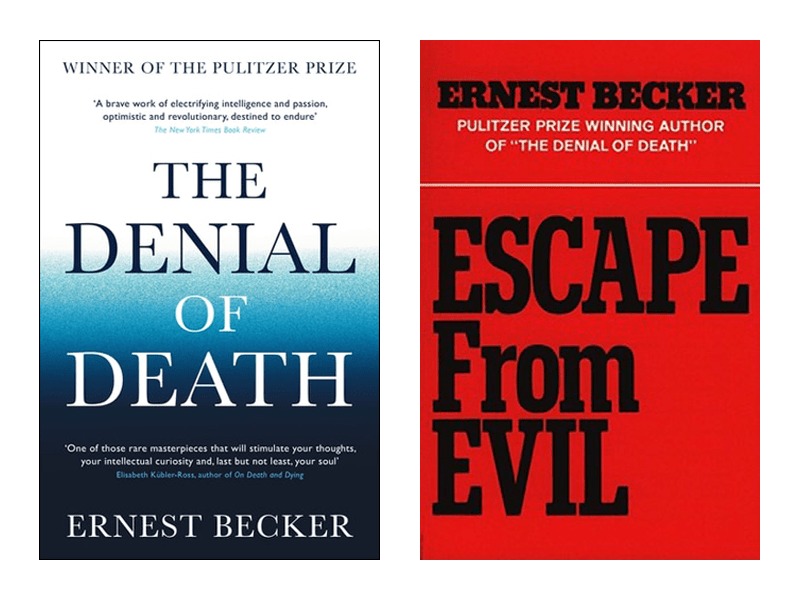
My background for wanting to read these books is deconverting from my Fundamentalist Christian beliefs in 2017. I knew I wasn’t going to Heaven, so suddenly death was final & more scary. When I first read The best books on Fear of Death recommended by Sheldon Solomon from Five Books I felt some encouragement that there were people out there thinking about death & wrestling with what it means.
From the Five Books article it is clear Sheldon Solomon thinks Becker is an important stop on the road to understanding fear of death. I tried to read Escape From Evil first but because I had done so little reading on this topic I lacked the background to understand it easily, so reading Denial first seemed mandatory. Denial of Death comes first chronologically and is the one he completed before he died (his widow published Escape). Denial of Death I think lays the platform for Escape. Escape From Evil is the better, more concise book, but I think Denial is essential reading to get the most out of it.
In Denial of Death Becker makes his case for fear of death affecting all areas of our lives. He sees the major breakthrough in understanding this as being Freud’s, but, writing in the 1970s, he thought Otto Rank (a disciple of Freud) had built the most on Freud’s work on existentialism. Becker makes a compelling case but stops short in Denial of suggesting a way forward. You get the feeling he felt compelled to have a go, and Escape was probably going to be his attempt.
Denial of Death is over 50 years old now. The stuff in there about mental health feels very outdated. I don’t know where he was coming from about homosexuality & transvestism. The attempt to psychoanalyse Freud’s two known fainting spells feels too long. The summaries of Kierkegaard and Rank’s bodies of work are fascinating; as is his conclusion that those two thinkers thought that the cosmic heroism embedded in religion was the best treatment for the fear of death. Indeed, Becker goes as far as to say ‘The urge to cosmic heroism, then, is sacred and mysterious and not to be neatly ordered and rationalized by science and secularism. Science, after all, is a credo that has attempted to absorb into itself and to deny the fear of life and death; and it is only one more competitor in the spectrum of roles for cosmic heroics.’
Combined together, Denial of Death & Escape From Evil are the most important books I have read in the last 10 years. They are still massively relevant today and our reckoning with their questions & challenges as a species is way overdue. Chapters 1 and 2 of Escape From Evil seemed to me to be mostly an attempt to provide the reader with some of the background he covered in Denial. Readers of Denial of Death can probably pick up from chapter 3 onwards. Becker takes as his starting point that fear of death shrouds & affects all our waking moments, and goes on to show how inequality, status, genocide, the accumulation of capital/possessions/power are all symptoms of our failure to ultimately reckon with death-terror. Reading the last chapter, Becker seems caught between humility and honesty. He says ‘No one mind can pose as an authority on the future; the manifold of events is so complex that it is fraud for the intellectual to want to be taken seriously as a prophet, either in his fantasies or in his realities.’ But then on the same page he says ‘Yet I think that there is a solid minimum achievement’. Becker’s prescription? Progressive politics and a “science of society”. I was underwhelmed by this but I was probably expecting too much.



 Oblivion With Bells